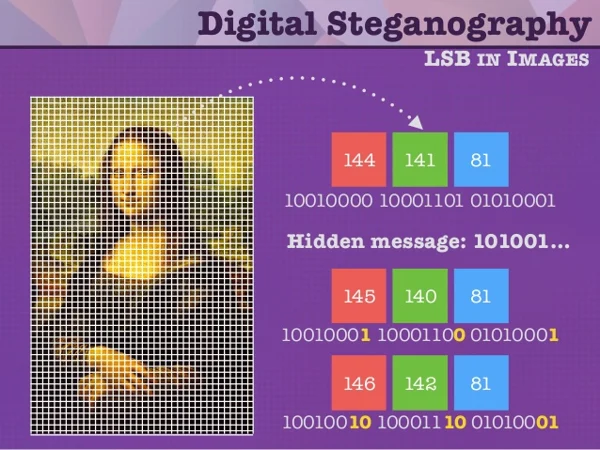
According to ChatGPT, steganography can be broken down into 4 key steps: Selecting cover media, embedding the image, transmission or storage, and recovery of the message. Steganography is not a new process and has been done for years; ChatGPT said the first to do this was Greece. Their form of steganography was tattooing messages on slaves’ heads, then when their hair grew back, they would send the recipient the message. Nowadays, the method has advanced to the point where texts are hidden inside pixels and cannot be seen by the naked eye. ChatGPT explains the process: The sender encodes the message into the LSBs of the pixels in the cover image. Each character of the message is converted into its binary representation, and the LSBs of selected pixels are replaced with the bits of the message (LSB stands for least significant bit). More simply stated, this is done by altering the bits inside one of the pixels so slightly that the color of the image remains the same. However, once the image is put inside a decoder, we can see the words left behind inside the image.
The benefit of this technique is to secretly transmit information to another party without it being intercepted. This process of transmitting the image to another party is tricky because if someone is going through the means of hiding the message, what is the best way to send it without it being stolen? The safest way to send a message would probably still be in person because technology is complicated these days, and people are able to decode the most complicated codes. The process of hacking into communication lines is getting riskier too.
Bold text generated by ChatGPT
Proof read by ChatGPT